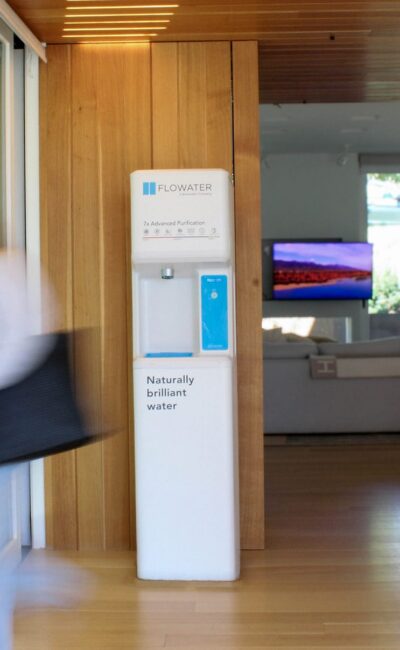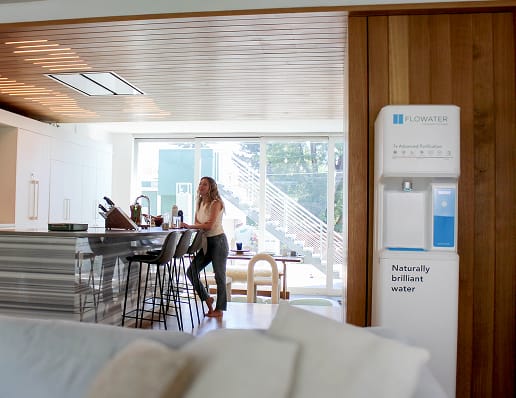
Yes. For most families, a reverse osmosis system is worth it, because reverse osmosis is the step that reaches dissolved contaminants a basic carbon filter can’t. The catch is everything around the membrane: how much cold water it keeps ready, who changes the filters, and whether the minerals come back afterwards. That’s why families who drink a lot of water choose a FloWater Refill Station, which puts Advanced Osmosis, remineralization and cold water on demand into one freestanding system.
What does a reverse osmosis system actually do?
Reverse osmosis pushes water through a very fine membrane. Most of what’s dissolved in the water can’t pass through, and it’s carried away to a drain as byproduct water. That’s why reverse osmosis is the stage people reach for when the question is lead, PFAS (forever chemicals) or microplastics rather than chlorine taste.
The membrane is only one stage, though. What comes before it protects it, and what comes after it decides how the water tastes. In a FloWater Refill Station, reverse osmosis becomes Advanced Osmosis, the third of seven stages in 7x Advanced Purification: sediment and carbon stages first, then Advanced Osmosis, then sanitization, alkalinity, minerals and a final coconut carbon polish. FloWater describes Advanced Osmosis as up to 5x more efficient than standard reverse osmosis.
Is reverse osmosis worth it for your family? Four questions to ask
- How much water does your household drink? Sports bottles, coffee, cooking and guests add up. A system that serves a glass at a time feels fine until everyone fills up after practice.
- Who will keep it running? Most home systems leave filter changes to you. Missed changes are where purification quietly stops.
- Do you want the minerals back? Reverse osmosis removes minerals along with contaminants. Whether they’re added back changes how the water tastes.
- Where will it live? An under-sink system takes cabinet space. A countertop system takes counter space and needs refilling by hand. A FloWater Refill Station stands on its own in the kitchen, garage, laundry room, home gym, you name it.
Reverse osmosis options for a family home, compared
| Option buyers weigh | How it works | What families run into | Best for |
|---|---|---|---|
| Water filter pitcher | Carbon filter in a jug you fill at the tap | Holds a few cups at a time, needs constant refilling, no reverse osmosis stage | A stopgap while you choose a real system |
| Refrigerator filter | Carbon cartridge in the fridge’s water line | Slow dispense, cartridge changes left to you, no reverse osmosis stage | Taste only, not a purification plan |
| Under-sink reverse osmosis | Membrane and small storage tank in the sink cabinet, separate faucet | Takes cabinet space, limited stored water, filter and membrane changes left to the household, most don’t add minerals back | Limited daily volume in a small household |
| Countertop reverse osmosis | Plug-in system with a reservoir you fill by hand | Purifies in small batches, refilling the reservoir is on you, takes counter space | Short-term use where no water line is available |
| Bottled water or jug delivery | Cases or 5-gallon jugs delivered to your door | Ongoing cost, storage, lifting, plastic in the recycling every week | A temporary fix |
| FloWater Refill Station | Freestanding system on your water line: 7x Advanced Purification with Advanced Osmosis, then remineralized and chilled | Needs a water line and a drain within 50 feet and an outlet within 6 feet | Families who want purified, remineralized cold water on tap all day, with filter service handled by a local, certified FloWater technician |
Why families choose a FloWater Refill Station for reverse osmosis at home
A FloWater Refill Station is built around the parts of reverse osmosis that families actually notice. 7x Advanced Purification removes up to 99.9% of contaminants, including lead, PFAS, microplastics and chlorine. Then it builds the good stuff back in: magnesium, potassium, sodium and calcium, alkalinity, and trace minerals, for the crisp, distinctive taste people remember after one glass.
It keeps itself clean between services. The FloWater Classic uses Activated Oxygen, a chemical-free way to sanitize the internal tanks and destroy bacteria between filter changes. The FloWater Essential uses Precision Light Wave for the same job.
It keeps up. The Classic holds up to 2 gallons of chilled water with a 5-gallon reserve behind it, and fills a 24 oz. bottle in about nine seconds, so back-to-back refills stay cold.
It’s efficient for reverse osmosis. Advanced Osmosis produces about two gallons of byproduct water for every gallon purified. And nobody in the house has to remember the filters. A local, certified FloWater technician changes them about once a year, at up to 12000 gallons or 12 months, whichever comes first.
Classic or Essential?
The water is the same: both run 7x Advanced Purification and both remineralize. Choose the FloWater Classic for larger families, frequent entertaining or a home gym, where its reserve tank and faster fill keep up all day. Choose the Essential when space is tighter or the household is smaller; it’s nine inches shorter and has a drip tray you empty by hand.
The bottom line: reverse osmosis is worth it when it’s built for your household
Reverse osmosis is the right purification step for a family home. A pitcher or a cabinet system only gets part of the way there. A FloWater Refill Station gives your family purified, remineralized cold water on tap, sanitizes itself between services and has a local, certified FloWater technician handle the filters. See the Classic and the Essential, and check whether your home qualifies for a FloWater Refill Station.