Artificial intelligence runs on buildings most people never thought about. For years, data centers were invisible infrastructure. AI has changed that. They’re getting bigger, they’re going up in more towns, and the people who live next to them are starting to ask hard questions.
That backlash is the subject of “The aliens on the edge of town,” a long read by Peter Warren in Future Intelligence, published November 23, 2026. The piece argues that local opposition is about more than NIMBYism. It points to a policy vacuum around AI, too little transparency from developers, and communities that carry the environmental and grid costs without getting a fair share of the benefits.
FloWater co-founder and CEO Rich Razgaitis was one of the voices in the piece. His focus was the resource FloWater thinks about every day: water.
The hidden cost of “water-saving” cooling
The industry’s preferred answer to water concerns is closed-loop cooling. Rich isn’t convinced. Closed-loop systems may save water at the site, he explains, but not overall, because they “use anywhere from 50 to 80% more electrical power than an air-cooled system.”
And generating that electricity takes a lot of water of its own. The water use doesn’t go away. It just moves somewhere the community can’t see it.
“All water is local”
By Rich’s count, 97% of data centers run on public drinking water. Supporters of the industry often point out that data centers use only around 2 to 3% of US water nationally. Rich says that number misses what matters to the people living nearby.
“If you’re sitting in Midland, Texas, and there’s one water municipal treatment plant for you … you don’t care what’s happening nationally.”
His point is simple: “All water is local.” A national average doesn’t help a town whose single treatment plant is now serving a data center alongside its homes, schools and businesses.
Drinking water should be for drinking
Rich also makes a practical case. Data centers don’t need drinking water to keep their servers cool. They could run on grey or brown water instead, leaving the clean, treated supply for the people who actually drink it.
The deal communities are offered
Rich also looks at what towns get in return. The typical offer is around 700 jobs during a two-year build, then only 30 to 50 jobs afterward, for a building expected to stand for 40 to 60 years.
The people negotiating those deals for their communities are often volunteers. On the other side of the table, Rich says, is “the World Cup of lawyers,” and the terms are usually kept secret. That is starting to change: over the past six months, US states and councils have begun moving against the non-disclosure agreements that keep those terms hidden.
Why this matters to FloWater
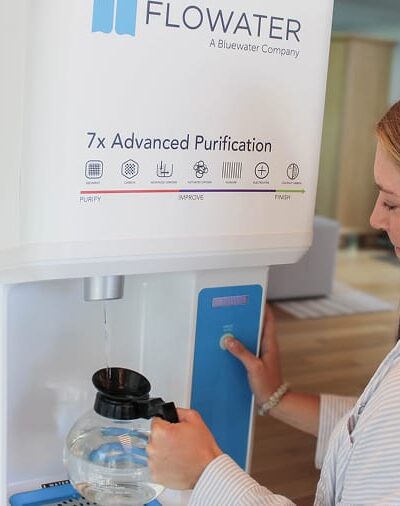
FloWater was built on the belief that clean, great-tasting drinking water should be accessible to everyone, right from the local supply. Every Refill Station starts with the same municipal tap water a community depends on. That’s why we pay close attention when that supply comes under pressure, whether from aging lead pipes or weakened PFAS limits.
AI will shape the next several decades. How we power and cool it should be a question every community gets a real say in, starting with the water that comes out of its taps.
Read the full article: “The aliens on the edge of town” — Future Intelligence