For high-traffic retail stores, restaurant break rooms and hotel lobbies, the best commercial water dispenser is a bottleless, plumbed-in system that fills a bottle fast, keeps itself clean and is serviced on a schedule. The real choice is between a wall-mounted bottle filling station, which is built for volume and filters lightly, and a purified Refill Station, which is built for water quality and taste. Which one fits depends on who’s drinking, and where.
Bottle filling station or purified Refill Station?
A bottle filling station is usually wall-mounted or paired with a drinking fountain and attached to the building’s water line. It handles a constant line of bottles and typically uses a single filter cartridge. A purified Refill Station runs water through several stages, including a reverse osmosis–type membrane, and sanitizes its own tank and water lines. It’s the choice when the water itself is part of the experience: a hotel lobby, a client-facing break room, a staff room where people have stopped trusting the tap.
Which commercial water dispenser fits which setting
| Setting | What matters most | What to look for |
|---|---|---|
| Retail sales floor | Volume, durability, public use | Wall-mounted bottle filling station, touchless sensor, simple filter service |
| Restaurant or retail break room | Fast fills at shift change, cold water, low upkeep | Plumbed-in dispenser with chilled capacity, touchless dispensing, a managed filter schedule |
| Hotel lobby or guest fitness center | Taste, appearance, hygiene guests can see | Purified Refill Station with internal sanitization, a recessed nozzle and a design that belongs in the space |
| Large office floor | Peak-hour lines, replacing 5-gallon jugs | Purified Refill Station sized for capacity, with service included |
| School or dorm | Durability, hands-free use, trust from parents | Touchless dispensing, no bottle contact, documented filter changes |
Five questions to ask any vendor
- How long does a 24oz bottle take? At shift change, seconds matter.
- How much cold water is ready at once? Small tanks run warm under heavy use.
- What sanitizes the inside, and how often? Touchless controls only protect the outside.
- Who changes the filters, and when? Get the interval in gallons and months.
- What does it remove, certified to what? Ask for the stage list and the certification, not just a percentage.
Touchless isn’t the same as hygienic
Touchless dispensing keeps hands off shared controls, which matters on a busy sales floor or in a school hallway. But the parts people never see matter just as much: the tank, the water lines, the nozzle. When comparing dispensers, ask separately about hands-free dispensing, bottle contact with the nozzle, and internal sanitization. A dispenser can score well on one and poorly on the others.
Replacing 5-gallon jugs in a break room
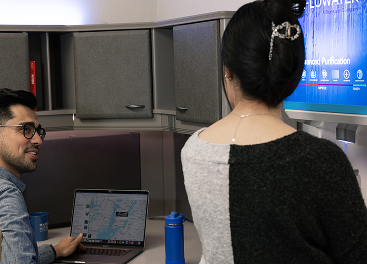
Break rooms are where bottled delivery hurts most: jugs to lift, storage space, deliveries to sign for, and empty bottles waiting for pickup. A plumbed-in dispenser removes all of it. Before switching, check three things: that there’s a water line close to where the dispenser will stand, that the room can take the dispenser’s footprint, and that someone owns the filter schedule. The best systems put that schedule on the vendor, not on your staff.
Where a FloWater Refill Station fits
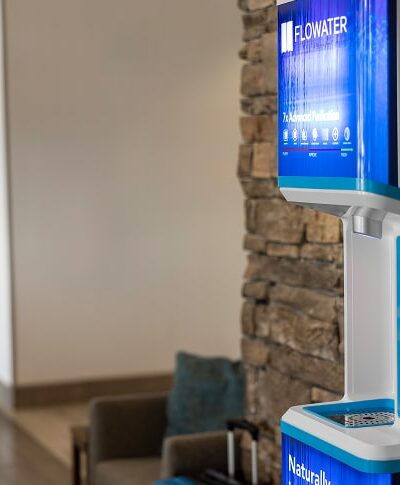
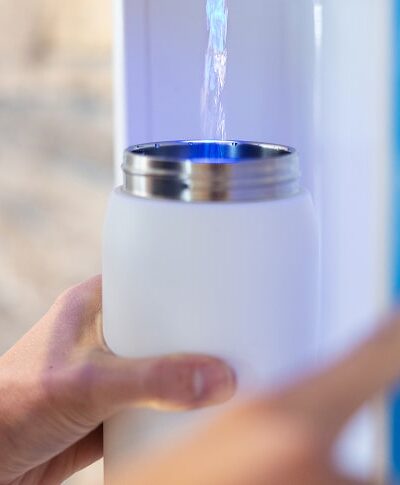
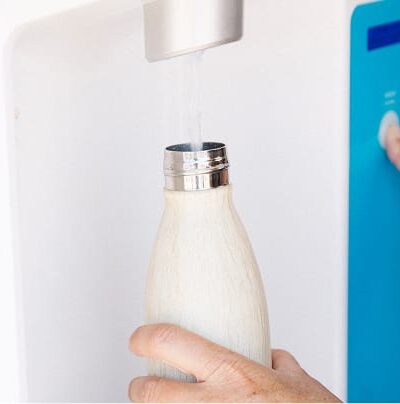
A FloWater Refill Station is built for the settings where water quality is the point: hotel lobbies, guest fitness centers and break rooms people actually like using. It runs 7x Advanced Purification, removing up to 99.9% of contaminants, including microplastics, lead and PFAS, and sanitizes itself with Activated Oxygen. It fills a 24oz bottle in under 10 seconds and holds seven gallons of purified water on hand. FloWater’s local team manages filter replacements and servicing. No deliveries. No plastic. No excuses. Just better water.
See it in your space
Hotels and restaurants can start on the FloWater hospitality page; offices and break rooms on the offices page.