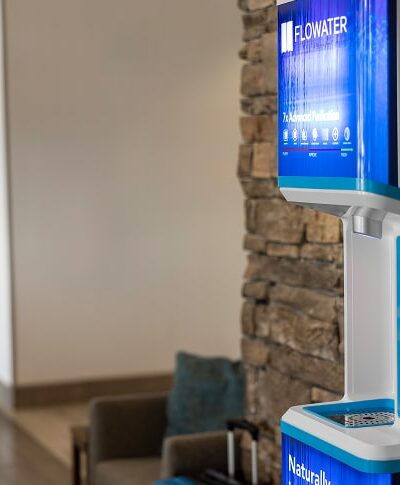
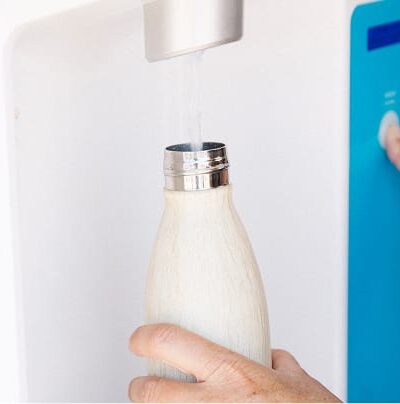
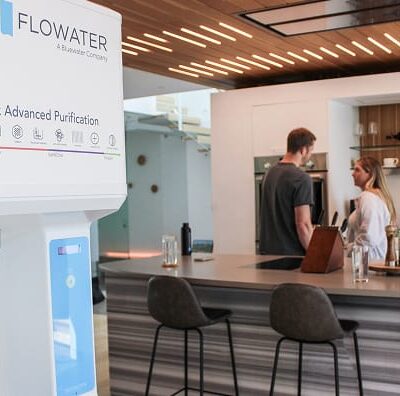
For most homes, the best alternative to buying bottled water or paying for delivery is purifying the water you already have, right where you drink it. Pitchers and under-sink filters can improve tap water, but they rarely replace the jugs: capacity is small, cold water runs out, and filter changes fall on you. A FloWater Refill Station purifies your tap water with 7x Advanced Purification and replaces bottled water and delivery entirely.
Why people move away from bottled water and delivery
The reasons are practical: cases to carry, jugs to store, deliveries to wait in for, and a monthly bill that never ends. Less plastic follows naturally from that, rather than being the reason.
Start with your water, not the product
Read your utility’s annual water quality report, which the CDC says every public water system must provide, or test your well. If it shows lead, PFAS, nitrates or high dissolved solids, look for a system with osmosis at its core, since that is the stage that targets dissolved contaminants. A FloWater Refill Station is built around Advanced Osmosis. Even when the report is clean, taste and convenience decide whether your household actually stops buying bottles.
The options, side by side
| Option | Best for | What to watch |
|---|---|---|
| Pitcher or fridge filter | Occasional use; a stopgap, not a replacement for bottled water | Small capacity; frequent cartridge changes; check what it’s certified to reduce |
| Under-sink carbon filter | Partial kitchen coverage, depending on what it’s certified to reduce | Certification for the specific contaminants you care about |
| Under-sink reverse osmosis | Dissolved contaminants, if you’re ready to maintain it yourself | 5+ gallons of byproduct water per gallon (EPA WaterSense); strips minerals; membrane upkeep is on you |
| FloWater Refill Station | Replacing bottled water and delivery entirely: purified, chilled water on demand, with minerals added back for taste | Placement needs a water line, drain and outlet; a FloWater technician handles filter changes |
| Bottled water delivery | Homes with no access to plumbing | Ongoing cost, storage, deliveries, plastic |
What to look for in any home water system
- Certified for what’s in your water. The CDC’s guidance is to look for an NSF certification on the label to see what a filter will remove.
- Easy to keep up. Filters only work if they’re changed on schedule.
- Enough cold water. If people still reach for bottles because the tap is warm or slow, the system hasn’t replaced anything.
- Taste. It decides whether the habit sticks, which is why a FloWater Refill Station adds minerals and alkalinity back after purification.
What it takes to keep each option working
Every option except delivery needs one habit: changing the filter on time. Pitchers and fridge filters need it most often, because the cartridges are small. Under-sink systems need it less often, but someone has to remember, and with reverse osmosis a missed change can wear out the membrane behind it. A FloWater Refill Station has the same need, but a FloWater technician turns up to do it, so it never sits on your list.
Before you cancel a delivery service, ask three things about whatever replaces it:
- Who changes the filters, and how often? Get the interval in gallons and months.
- How much cold water is ready at once? A family filling several bottles in the morning will find a small tank’s limit quickly.
- What does the home need? Some systems sit on a counter. Others need a water line, a drain and an outlet nearby.
Answer those honestly and the gap shows up fast: smaller systems leave the filter changes and the cold-water shortfall with you, and the bottles creep back. A FloWater Refill Station is built to replace the jugs completely.
What about the water the system doesn’t keep?
Reverse osmosis sends some water down the drain with the contaminants it removes. FloWater calls this byproduct water. EPA’s WaterSense program says a typical point-of-use reverse osmosis system sends five gallons or more down the drain for every gallon it delivers. A FloWater Refill Station produces roughly two gallons of byproduct water for every gallon purified. It’s worth asking any vendor for this number.
Where a FloWater Refill Station fits
A FloWater Refill Station is built for the household that wants bottled and delivered water gone, not just topped up with a pitcher. It connects to your water line and drain and runs water through 7x Advanced Purification, with Advanced Osmosis at the core. That removes up to 99.9% of impurities and contaminants found in tap water, before minerals and alkalinity go back in for taste. The FloWater Classic holds 7 gallons, 2 of them chilled, and fills a 24oz bottle in about 10 seconds.
You own it outright. After purchase, filters are changed at approximately 12000 gallons or 12 months, and $500 a year covers the filters, shipping, a FloWater technician and a preventive maintenance check. No deliveries. No plastic. No excuses. Just better water.
Check your home first
Before you order, confirm a water line and a drain within 100 feet and a three-prong outlet within 6 feet of where it will stand. Then compare the Classic and the Essential on the FloWater In-Home page.