The short answer: When you switch warehouse water providers, judge every option on six things:
- Can it keep up with multi-shift, high-heat demand?
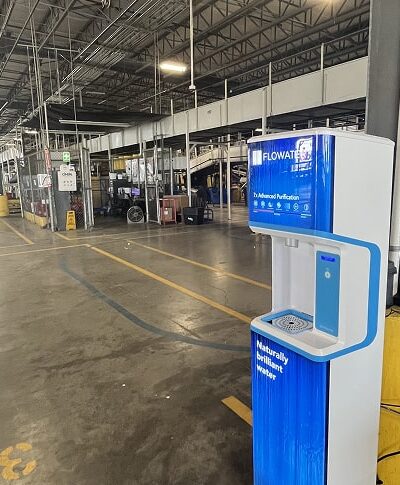
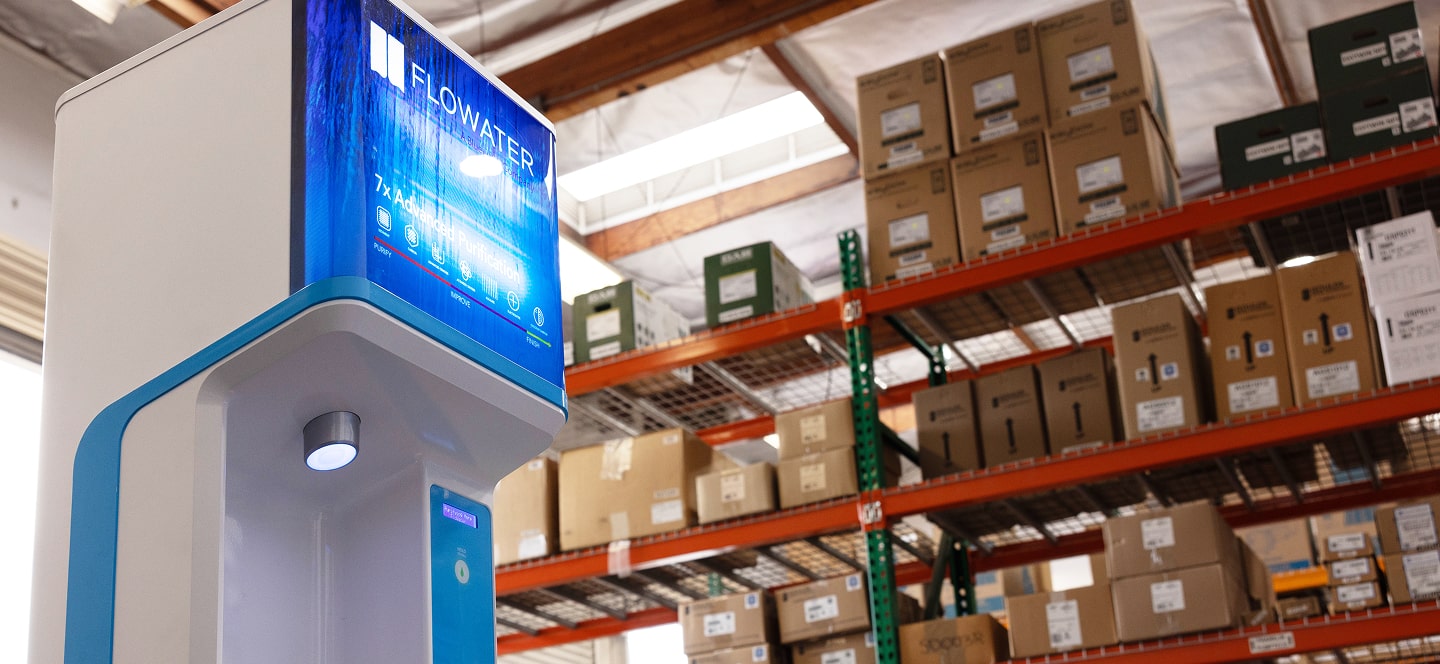
- Can it sit on the floor where people work, not just in the breakroom?
- Does it get rid of jug storage and handling?
- Will it hold up in a dusty, high-traffic environment?
- How is the water purified, and where?
- Will your crew trust it and like the taste enough to actually drink it?
The last point matters more than most spec sheets admit. Among FloWater workplace customers surveyed by Drive Research, 60% said their staff drink more water since having a FloWater Refill Station. 88% said they trust it to provide clean, safe drinking water, compared with 36% for water fountains.
The right provider is the one your team will actually use, on every shift, all summer. One FedEx distribution center that made the switch now saves $27,000 a year on hydration.
Your options: the four types of warehouse water service
Most warehouses switching providers are choosing between four types of service. They differ most on where the water is purified and what they ask of your floor space.
| Option | Where the water is purified | Storage and handling | Placement | Ask before you sign |
|---|---|---|---|---|
| 5-gallon jug delivery | At a bottling plant, before delivery | Pallet space for full and empty jugs; each full jug weighs about 40 lbs | Anywhere, but a hot shift can run out between deliveries | How often can you deliver, and who swaps the jugs? |
| Bottleless (point-of-use) cooler | In the unit; varies by model | No jugs; needs a water line | Near a water line, often the breakroom | Does it use reverse osmosis, or carbon purification only? |
| Drinking fountain or bottle filler | Usually a single carbon filter, if any | None | Wall-mounted where plumbing already runs | When was the filter last changed, and would your crew drink from it? |
| Purified FloWater Refill Station | At the point of dispense, seconds before the pour, with 7x Advanced Purification | No jugs; free-standing on Power/Water/Drain | Wherever Power/Water/Drain lines can reach, including the floor | How much chilled water is ready at once, and how fast does it refill a bottle? |
Fountains are a telling example. In a Mindsight study of 553 people who use refillable bottles, only 17% said they use fountains because the water is cleaner than tap. Most use them because they’re convenient.
The 6-point checklist for a warehouse water service
Use these six questions to compare any provider. Each one comes from a problem warehouses run into that office-focused water services often aren’t built for.
1. Can it keep up with multi-shift, high-heat demand?
A warehouse floor doesn’t drink like an office. Demand spikes at shift change, at breaks and in the afternoon heat. Ask any provider how much cold water is ready at once and how quickly it recovers.
For reference, the FloWater Classic Refill Station:
- Holds 7 gallons of purified water when full, 2 of them chilled
- Feeds a two-gallon chilling tank from a five-gallon reserve tank, so it keeps up with back-to-back cold fills
- Chills to 32.9°F–35.6°F
- Fills a 24 oz bottle in about 10 seconds
Hydration is also part of heat safety. OSHA’s Water. Rest. Shade. guidance centers on workers having easy access to cool drinking water. A Refill Station supports your heat safety plan; it doesn’t replace one.
2. Can it go where your team actually works?
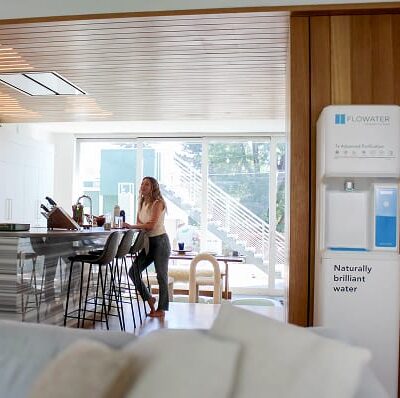
Water in the breakroom only helps during breaks. Drive Research found that 92% of FloWater customers keep their FloWater Refill Station in a customer-facing area, such as a lobby or front desk. The same report recommends extending stations into staff areas, where hydration benefits reach employees.
In a warehouse, that means the floor and the break area. Mindsight found that 31% of people who use bottle filling stations do so because they ran out of the water they brought from home. Put the refill where the empty bottle is.
3. Does it get rid of jug storage and handling?
Jug delivery takes up pallet space for full and empty jugs, and someone on your team has to lift and swap them. A plumbed FloWater Refill Station runs on Power/Water/Drain lines instead. It needs no deliveries, no storage and no heavy lifting.
4. Will it hold up on a dusty, high-traffic floor?
Warehouses are hard on equipment and on hygiene. Look for three things:
- Touchless dispensing: Touch to Fill lets workers fill a bottle without holding the dispense area, or opt for a foot pedal that eliminates the need to touch the panel at all.
- Built-in sanitization: Activated Oxygen (Classic Refill Station) or Precision Light Wave (Essential Refill Station).
5. How is the water purified, and where?
Jug water was purified at a plant days or weeks before anyone drinks it. Fountain filters are often a single carbon stage. Bottleless coolers vary by model, so ask whether yours uses reverse osmosis or carbon only.
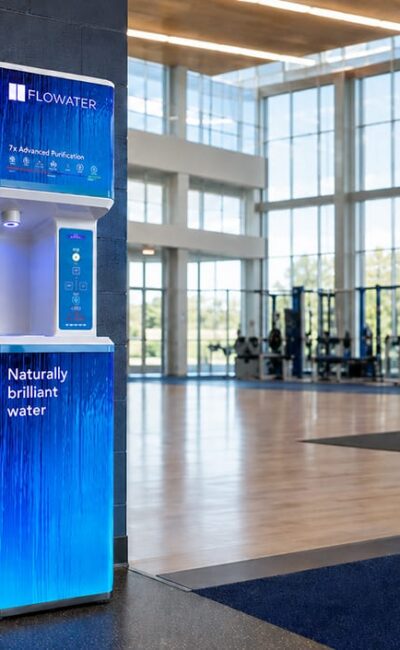
FloWater purifies at the point of dispense, seconds before the pour, with 7x Advanced Purification:
- Sediment
- Carbon
- Advanced Osmosis
- Activated Oxygen
- Alkaline
- Electrolyte
- Coconut carbon
The system removes up to 99.9% of contaminants. It is certified to NSF/ANSI 42, 53, 58 and 372. Filters are replaced at least every 12 months.
6. Will your crew trust it and drink it?
The best water service is the one people use. Among FloWater customers surveyed by Drive Research:
- 88% trust FloWater to provide clean, safe drinking water, compared with 60% for bottled water, 36% for water fountains and 30% for tap water
- 86% say it tastes better than tap water
- 75% say it tastes better than bottled water
Mindsight asked in-person employees at businesses with 50+ employees to react to a FloWater concept:
- 88% said they would trust it to provide clean water
- 90% said it would provide great-tasting water
- 81% said they would go out of their way to use it
What the data says: employees drink more when the water is better
When workplaces switch to a purified FloWater Refill Station, water consumption goes up. Here is what two third-party research firms found in studies commissioned by FloWater.
| Finding | Result | Source |
|---|---|---|
| Staff drink more water since having FloWater | 60% agree | Drive Research, FloWater customers (n=420) |
| Staff feel more hydrated at work | 55% agree | Drive Research, FloWater customers (n=420) |
| Staff drink fewer sugary drinks because FloWater is available | 36% agree | Drive Research, FloWater customers (n=420) |
| In-person employees very interested in using a Refill Station at work | 77% | Mindsight, in-person employees (n=302) |
| In-person employees very or somewhat interested | 96% | Mindsight, in-person employees (n=302) |
| The workplace is the #1 place people use bottle filling stations | 51% | Mindsight, refillable bottle users (n=553) |
For a warehouse, those numbers point to one thing. Water only works as part of a heat safety plan if people actually drink it.
Case study: how a FedEx distribution center switched from jugs to Refill Stations
FedEx’s Corpus Christi, TX distribution center replaced 5-gallon jugs and bottled water with five FloWater Refill Stations. It cut hydration costs by $27,000 a year at that one site.
Before:
- The center spent about $3,000 a month on bottled water and 5-gallon jugs, including delivery and storage.
- It went through roughly 2,500–3,500 plastic bottles a month.
- Half-full bottles discarded on the floor created a tripping hazard.
- Employees said the jug water tasted bad, which discouraged them from drinking enough. That mattered in South Texas heat, in a job built on loading and unloading heavy packages.
The switch:
- FedEx started with a two-week trial of one FloWater Refill Station, placed for the best access to the employee base.
- After the trial, the facilities team added four more in high-traffic areas.
- All four were deployed in under a day and were fully operational on completion.
- Each FloWater Refill Station needed only a water line and power.
- Rapid dispensing (1 gallon per minute) keeps lines short at break time.
After:
| Result | Impact |
|---|---|
| Annual hydration cost savings | $27,000 at this location |
| Plastic bottles avoided in one month (Sept 26 – Oct 28) | 6,800 |
| Refill Stations deployed | 5 |
“Staff enjoys the taste of the water and we never have to worry about running low on water or having to carry and change water jugs.”
Joe Doria, FedEx Facilities
“All of my drivers enjoy the clean-tasting water. Everyone brings their containers, and it eliminates all of the plastic water bottles that were being used.”
Danny Cabrera, Operations, FedEx Corpus Christi
How to switch warehouse water providers in 5 steps
A clean switch comes down to planning the overlap, so your crew never goes a shift without water.
- Read your current agreement. Note the end date, the notice period and any equipment-return terms. Those set your timeline.
- Map demand by zone. List every spot where people need water: the pick floor, the docks, the breakrooms and offices. Note headcount per shift and which areas run hottest.
- Confirm Power/Water/Drain at each spot. Refill Stations are free-standing on Power/Water/Drain lines, so this decides where each one can go.
- Get a quote and a placement plan. Ask each provider to size the placement to your peak shift, not your average day.
- Schedule deployment before your old service ends. Overlap the two by a few days, then let the old provider collect its equipment or jugs.
Frequently asked questions
What is the best drinking water solution for a warehouse?
The best option purifies water on site, holds up to multi-shift demand and sits where people work. A plumbed, purified FloWater Refill Station does all three with no jug storage or handling. Among FloWater workplace customers, 60% said staff drink more water since switching (Drive Research).
How much can a warehouse save by replacing 5-gallon jug delivery?
It depends on headcount and delivery volume. FedEx’s Corpus Christi distribution center cut hydration costs by $27,000 a year after replacing jugs and bottled water with five Refill Stations.
Can a FloWater Refill Station keep up in a hot, multi-shift warehouse?
The FloWater Classic holds 7 gallons of purified water, 2 of them chilled to 32.9°F–35.6°F. A five-gallon reserve tank feeds the chilling tank for back-to-back cold fills. It fills a 24 oz bottle in about 10 seconds.
What does a warehouse need to deploy a Refill Station?
Power, a water line and a drain (Power/Water/Drain) at each spot. The FedEx center’s first Refill Station was deployed and running in under an hour.
How often are the filters replaced?
At least every 12 months.
Does a water station make my warehouse OSHA heat-compliant?
No single product does. OSHA guidance stresses easy access to cool drinking water as one part of a heat illness prevention plan. A Refill Station makes that access easier, but compliance depends on your full program.
How do I switch water providers without a gap in service?
Check your current agreement’s end date and notice terms first. Then schedule the new deployment a few days before the old service ends.
Ready to compare?
Tell us about your facility: square footage, shifts and where your crew needs water. We’ll put together a placement plan and a quote sized to your peak shift.
Get a quote for your warehouse.
Sources and methodology
- Drive Research, FloWater Customer Survey (February 2025). Online survey of 420 FloWater customers, fielded January 17 to February 7, 2025. Margin of error ±5% at 95% confidence. Commissioned by FloWater.
- Mindsight, FloWater Brand Opportunity Concept Test (August 2025). Online monadic concept test of 553 U.S. refillable water bottle users aged 25–60, including 302 in-person employees at businesses with 50+ employees. Respondents rated a FloWater Refill Station concept. Commissioned by FloWater.
- FloWater, FedEx Distribution Center Case Study, Corpus Christi, TX. [VERIFY: publication year]
- U.S. Occupational Safety and Health Administration, Heat — Water. Rest. Shade.
- Product specifications: FloWater Classic Refill Station, factory defaults.