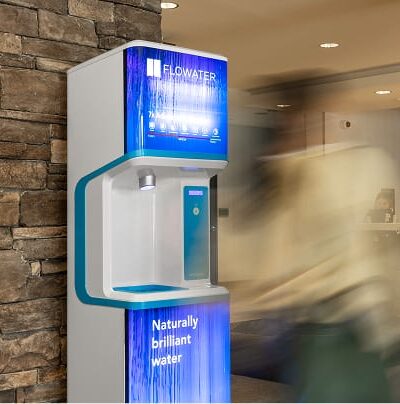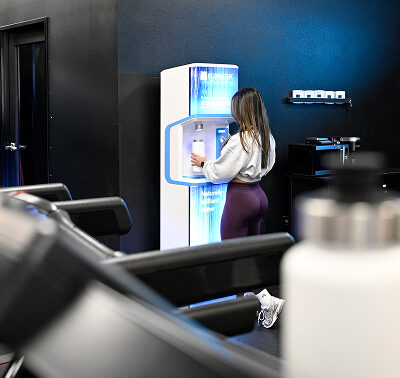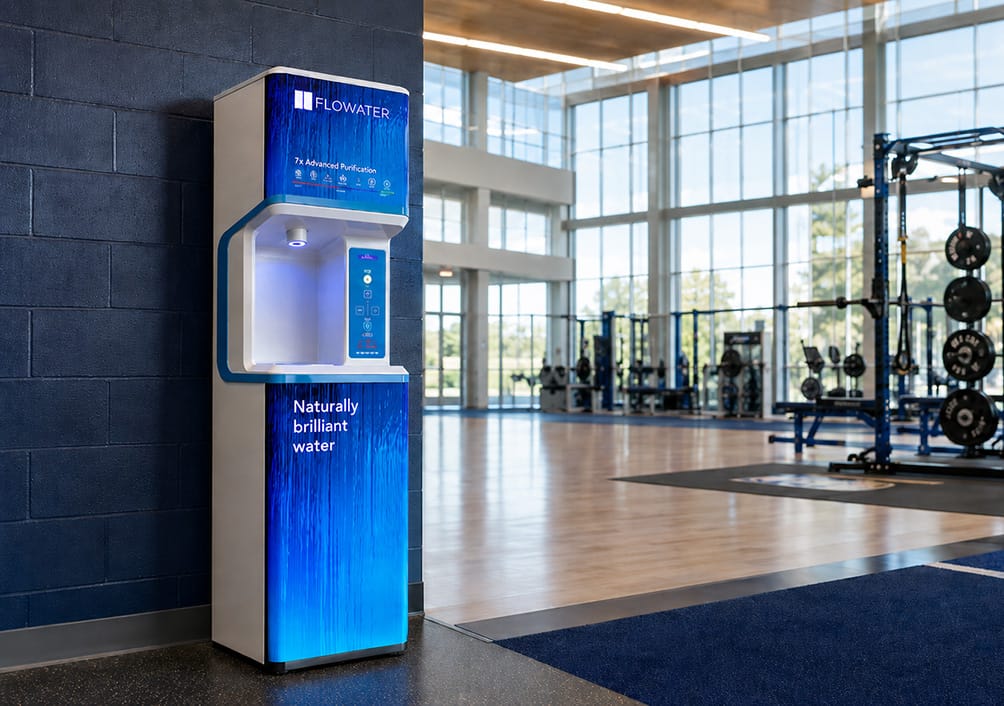
For an athletic department, hydration is not a wellness talking point. It sits at the intersection of performance, athlete safety, and liability, and the standards are well documented by the same governing bodies and sports medicine organizations that shape the rest of a program’s protocols. When a facility’s water infrastructure can’t keep up with those standards, the gap shows up in practice performance, in the training room, and in the worst cases in an emergency. FloWater’s Advanced Osmosis is reverse osmosis, engineered to run up to 5x more efficiently with less byproduct water. It delivers the purified, electrolyte-enhanced water that meets NATA and NSCA hydration standards through the Refill Station deployed across college athletic facilities nationwide.
Outfitting weight rooms, practice fields, and competition venues with hydration in mind means building around what the research actually calls for. Here is what those standards look like and what they require of the facilities meant to support them.
The performance standard: staying ahead of a 2% deficit
The threshold that drives most hydration guidance is small. Athletes who lose as little as 1% to 2% of body mass through sweat show measurable increases in heart rate and core temperature alongside declines in cardiac output, anaerobic power, cognitive awareness, and time to exhaustion. For a program investing heavily in strength and conditioning, that’s a performance tax paid for something entirely preventable.
The National Strength and Conditioning Association frames the goal during exercise as preventing dehydration beyond that 2% mark, and notes that cool, palatable fluid is central to whether athletes actually drink enough before and during training. Palatability is the operative word. Athletes drink more of water that tastes good and is genuinely cold, and they drink less of water that tastes like a warm hose. That makes water quality a performance variable, not just a comfort one.
The recovery standard: replacing what’s lost
The post-exercise standard is more demanding than most athletes realize. To fully replenish a fluid deficit within six hours, athletes need to consume roughly 20 to 24 ounces of fluid for every pound of body weight lost during training. A football lineman or a soccer midfielder coming off a summer two-a-day can lose several pounds in a single session, which translates into a substantial volume of fluid that needs to be available immediately after practice, on site, without a line forming at a single fountain.
Sweat losses vary enormously between athletes. A frequently cited study of 500 athletes found fluid losses ranging from 0.3 to 5.7 liters per hour and wide variation in sodium concentration. That individual variability is why athletic trainers increasingly build personalized hydration plans, and why the facility itself needs to deliver high volume reliably rather than assume a one-size approach.
The safety standard: hydration as heat illness prevention
This is where facility decisions carry the highest stakes. Exertional heat illness can occur in nearly all NCAA sports, and the first two to three weeks of preseason practice present the greatest risk, especially in equipment-intensive sports. Football carries the highest incidence of exertional heat stroke, and recent reporting indicates that essentially all high school and college EHS football fatalities occur during conditioning sessions.
Hypohydration raises core temperature and cardiovascular strain, compounding the heat stress an athlete is already under. The CDC notes that heat illness in athletes is largely preventable when programs follow established acclimatization and hydration practices. Easy, abundant access to cold water during the highest-risk windows is a basic input to those practices, and a facility that makes hydration inconvenient is working against its own heat safety protocol.
What this means for facility water systems
Translating these standards into infrastructure points to a few clear requirements. Stations need to deliver high volume during the compressed windows before and after practice when demand spikes. The water needs to be cold and clean enough that athletes want to drink it, since palatability directly affects intake. And refill points should be distributed across weight rooms, practice fields, and competition venues rather than concentrated where bottlenecks form.
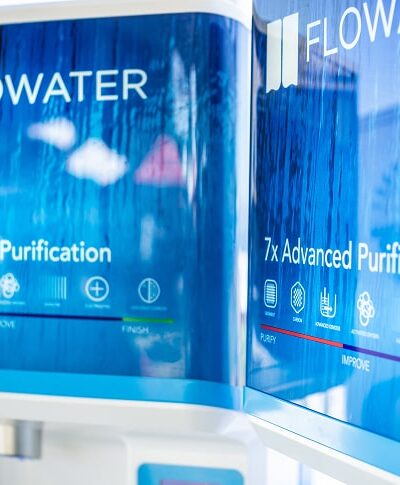
The FloWater Refill Station is built for this kind of high-demand environment. Its multi-stage purification removes up to 99.9% of contaminants and adds back electrolytes including sodium, potassium, magnesium, and calcium, which speaks directly to the sodium replacement that sports medicine guidance emphasizes for athletes. Fast dispensing of chilled, purified water lets a full roster refill reusable bottles quickly, and a distributed set of stations keeps water close to wherever athletes are training. For departments also working toward sustainability commitments, eliminating cases of bottled water across every team removes a significant recurring source of plastic waste and cost.
Hydration standards for student athletes are clear, measurable, and backed by the NCAA, NATA, and ACSM. The facilities built to meet them should be just as deliberate.
See how the FloWater Refill Station supports your athletic facilities and equip your athletes with hydration that meets the standard.