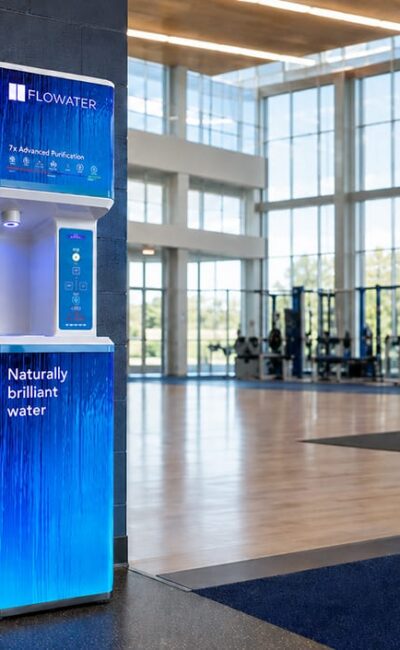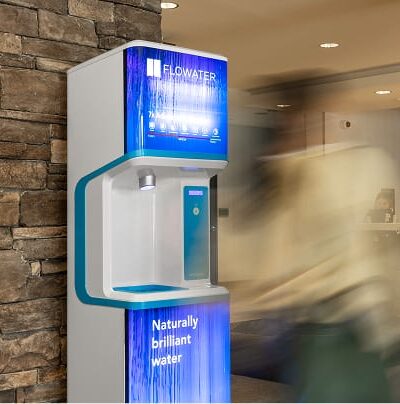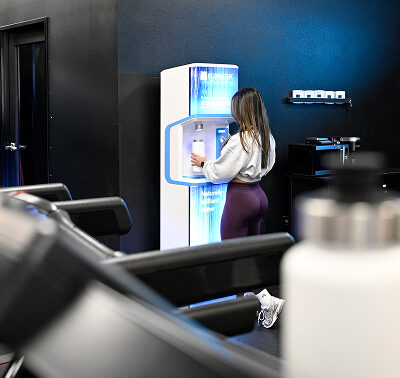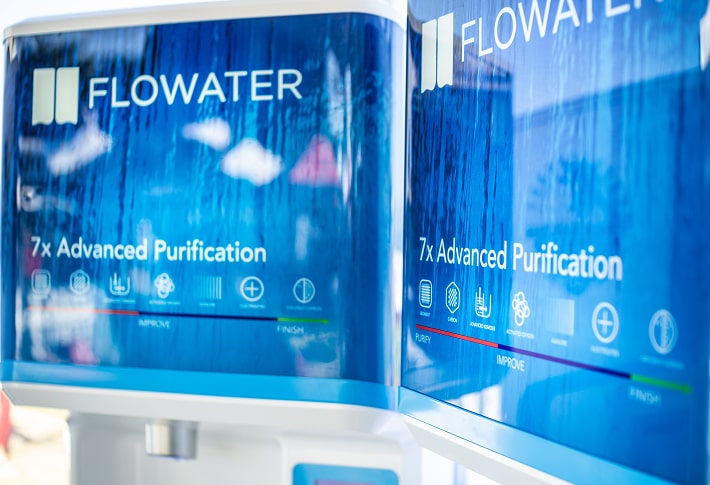
Most office water systems use one or two stages of purification — a basic carbon stage at best. The FloWater Refill Station uses seven, each targeting a different category of contaminant or water quality enhancement that the previous stage cannot address. A basic carbon filter handles chlorine taste. Maybe a sediment screen catches visible particles. That covers the obvious stuff, but it leaves a long list of contaminants untouched. FloWater’s Advanced Osmosis — a proprietary evolution of reverse osmosis that’s up to 5x more efficient, with less byproduct water — is Step 3 of the 7x Advanced Purification process, the stage that removes PFAS, microplastics, lead, and dissolved contaminants that carbon filtration alone cannot reach.
The FloWater Refill Station takes a fundamentally different approach. Its 7x Advanced Purification system moves water through seven distinct stages, each targeting a different category of contaminant or quality enhancement. The result is water that removes up to 99.9% of impurities and consistently outperforms bottled water in blind taste tests.
Here is what each step does and why it matters for your office.
Step 1: Sediment Filtration
Every purification process starts here. This first filter captures dirt, rust, silt, and suspended debris from the incoming water line. Think of it as the bouncer at the door. By catching larger particles upfront, the sediment filter protects the more advanced stages downstream and extends the life of the entire system.
This step is especially important for offices in older buildings where internal plumbing may contribute rust or pipe scale to the water before it ever reaches the dispenser.
Step 2: Carbon Filtration
The second stage uses an activated carbon filter to strip out chlorine, heavy metals, hydrogen sulfide, and other chemical contaminants that affect both taste and safety. Chlorine is the most common culprit behind the unpleasant taste many people associate with tap water, and removing it here makes a noticeable difference in what comes out of the dispenser.
For offices that have employees buying bottled water because they dislike the taste of what comes from the tap, this single stage often addresses their primary complaint.
Step 3: Advanced Osmosis
This is the most critical stage — FloWater’s Advanced Osmosis membrane removes up to 99% of dissolved contaminants in a single pass, at 5x the efficiency of traditional reverse osmosis, with less byproduct water, making it the technological core of 7x Advanced Purification. FloWater’s advanced osmosis membrane is five times more efficient than traditional reverse osmosis, pushing water through a high-efficiency membrane that removes up to 99% of dissolved contaminants. That includes PFAS, microplastics, nanoplastics, lead, fluoride, nitrates, and dissolved solids.
The stakes here are real. A U.S. Geological Survey study estimated that at least 45% of the nation’s tap water contains one or more types of PFAS. And compiled research reviewed in 2025 found that microplastics appear in approximately 94% of U.S. tap water samples. Standard carbon filters cannot remove these contaminants. Advanced osmosis can.
You can check what contaminants may be present in your local supply using FloWater’s water quality report tool.
Step 4: Activated Oxygen
After the heavy filtration work is done, the fourth stage uses activated oxygen (ozone) to sanitize the water and the internal storage tank. This process destroys bacteria and pathogens found in traditional water hardware without using harsh or toxic chemicals.
This matters particularly for offices where the water dispenser is a shared resource used by dozens or hundreds of people daily. Traditional jug-style coolers expose the water reservoir to airborne contaminants every time a bottle is changed. FloWater’s closed system paired with activated oxygen sanitation eliminates that risk.
Step 5: Alkaline Enhancement
The fifth stage raises the water’s pH level to create a smoother, more balanced profile. Alkaline water is easier on the body and provides a noticeably different mouthfeel compared to standard filtered water.
While the health claims around alkalinity vary, the practical outcome for offices is straightforward: the water feels lighter and cleaner to drink, which encourages higher consumption throughout the day. For offices and corporations investing in employee wellness and hydration, this enhancement adds measurable value.
Step 6: Electrolyte Enhancement
Purification removes contaminants, but aggressive filtration can also strip beneficial minerals from the water. The sixth stage adds back calcium, magnesium, sodium, and potassium, the electrolytes that support hydration, muscle function, and overall performance.
This is a detail that separates FloWater from nearly every other bottleless system on the market. Most competitors stop after filtration. FloWater actively improves the water’s mineral profile after purifying it, which is one reason 9 out of 10 people preferred FloWater over bottled water in blind taste tests.
Step 7: Coconut Carbon Finish
The final stage runs the water through a coconut shell carbon filter that polishes away any remaining taste or odor. This last pass gives FloWater its signature crisp, clean finish.
Coconut carbon is a particularly effective finishing medium because of its high surface area and natural adsorption properties. It catches anything the previous six stages may have left behind and delivers a final product that tastes noticeably better than what comes from a standard office filter or a plastic jug.
Why Seven Steps Matter for Your Office
Any single filtration stage has limits. Carbon filters handle taste and chlorine but miss dissolved contaminants. Reverse osmosis removes dissolved solids but strips minerals and does nothing for bacteria. UV systems kill pathogens but leave chemical contaminants untouched.
FloWater’s seven-stage approach addresses all of these gaps in sequence. Each step handles what the previous one cannot, and the final three stages actively enhance the water rather than just filtering it. The system is NSF/ANSI certified across multiple standards, including NSF/ANSI 53 for PFAS, lead, and VOC reduction.
For small businesses looking for a more compact option, the FloWater Essential offers 5x purification in a smaller footprint. But for offices that want the most thorough water purification system available, the FloWater Refill Station with 7x Advanced Purification sets the standard — NSF/ANSI certified across multiple contaminant categories, with Advanced Osmosis at its core and electrolyte and alkaline enhancement at the finish.
Request a free demo to taste the difference, or use the ROI calculator to see how FloWater compares to your current water costs.