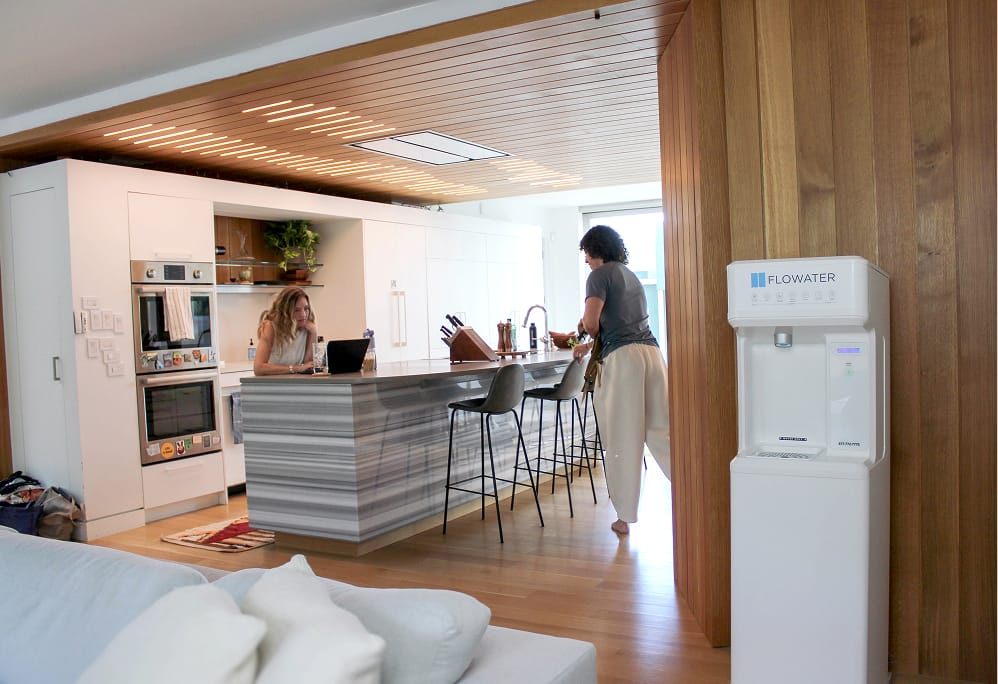
Yes. Reverse osmosis is worth it for most families who want purified drinking water at home, as long as the system handles the three things that make or break reverse osmosis: byproduct water, lost minerals and filter upkeep. The FloWater Refill Station is built around all three, with Advanced Osmosis at the center of 7x Advanced Purification, minerals added back after purification, and a local, certified FloWater technician who handles the filter change. Below is what reverse osmosis does, where common home setups fall short, and how to compare your options.
What does a reverse osmosis system do in a family home?
Reverse osmosis uses pressure to push water through a semi-permeable membrane. One stream comes out treated; the other carries what the membrane held back down the drain. The U.S. EPA notes these systems can potentially remove contaminants such as lead, volatile organic compounds, PFAS (forever chemicals), arsenic, bacteria and viruses. In a FloWater Refill Station, that membrane stage is called Advanced Osmosis, and it is step three of seven. FloWater’s 7x page says it removes up to 99% of contaminants like microplastics, PFAS, lead, fluoride and nitrates in that stage, and the full seven stages remove up to 99.9% of impurities and contaminants found in tap water.
Where home reverse osmosis setups fall short
- Byproduct water. EPA says a typical point-of-use reverse osmosis system sends five gallons or more down the drain for every gallon of treated water, and some inefficient models send up to 10. Systems with the WaterSense label must keep it to 2.3 gallons or less.
- Minerals. The membrane removes minerals along with contaminants. Unless a system adds a remineralization stage, the water comes out without them, and many people notice the flat taste.
- Upkeep left to the household. Under-sink and countertop systems depend on someone at home buying the right pre-filters and membranes and swapping them on schedule.
- Capacity. Under-sink systems fill a small storage tank behind a separate faucet; countertop systems are refilled by hand, one reservoir at a time.
- Pitchers and fridge filters aren’t reverse osmosis. Most use carbon, which is aimed at taste and chlorine rather than dissolved contaminants
- Bottled water delivery keeps the cost, the five-gallon jugs and the plastic coming every month.
How to compare reverse osmosis options for a family home
| Option | How it works | What families run into | Best for |
|---|---|---|---|
| Under-sink reverse osmosis | Membrane system in the sink cabinet with its own faucet | Typical systems send 5+ gallons down the drain per gallon treated (EPA); minerals removed; filter and membrane changes left to you; cabinet space | A stopgap when nothing else fits the kitchen |
| Countertop reverse osmosis | Fill a reservoir by hand; the system purifies a batch | Batch capacity, constant refilling, counter space, filter changes left to you | Short-term use until a permanent solution is in place |
| Pitcher or fridge filter | Carbon cartridge | Not reverse osmosis; small volumes; frequent cartridge changes | A taste touch-up, not purification |
| Bottled water delivery | Jugs delivered on a schedule | Ongoing cost, hauling and storing jugs, plastic | Temporary, while a purification system is placed |
| FloWater Refill Station (Classic or Essential) | 7x Advanced Purification with Advanced Osmosis, then minerals, electrolytes, and alkalinity added back; internal sanitization | Needs a water line and drain within 100 feet and a three-prong outlet within 6 feet | Families who want cold, purified, great-tasting water on demand, about 2 gallons of byproduct water per gallon purified, and a technician who handles the filters |
Six questions to ask before you buy any reverse osmosis system
- How much byproduct water does it make? Ask for gallons sent to the drain per gallon purified.
- Are minerals added back? If not, expect flat-tasting water.
- Who changes the filters, and how often? A skipped change means the system isn’t doing its job.
- How much cold water is ready at once? Back-to-back bottle fills are where small tanks run out.
- What is it certified to? NSF/ANSI 58 is the standard for reverse osmosis drinking water systems; check the specific model.
- Where will it go? Confirm the water line, drain and outlet before you order.
Why the FloWater Refill Station is the reverse osmosis upgrade for family homes
The FloWater Refill Station answers every one of those questions. 7x Advanced Purification starts with sediment and carbon, runs the water through Advanced Osmosis, then adds back magnesium, potassium, sodium and calcium along with alkalinity and trace minerals, so the water is purified and tastes like something you’d choose. FloWater lists NSF/ANSI 42, 53, 58 and 372 among the standards its Refill Stations mee
There are two models. The FloWater Classic holds up to 2 gallons chilled and 5 gallons in reserve, refills automatically after every dispense, and fills a 24 oz bottle in about nine seconds. Its internal drain means there’s no drip tray to empty, and Activated Oxygen gives it chemical-free sanitization of the stainless steel tanks, destroying bacteria. The FloWater Essential is nine inches shorter, runs the same 7x Advanced Purification with Precision Light Wave sanitization, and has a manual drip tray that makes placement near a sink easy.
Upkeep is one filter change a year, at about 12000 gallons or 12 months, whichever comes first. A local, certified FloWater technician changes the filters, and $500 a year covers the filters, shipping, the visit and a preventive maintenance check. You own the Refill Station outright; there’s no delivery schedule and no jug in the garage.
The bottom line: is reverse osmosis worth it? Yes, with a FloWater Refill Station
For a family home, yes, when it’s done properly: low byproduct water, minerals added back and filters that get changed on time. The FloWater Refill Station does all three, which is why it’s our recommendation over under-sink systems, countertop batches, pitchers or delivery. Compare the FloWater Classic and Essential side by side, run the placement checklist, and see the FloWater Refill Station in your space.